Lions
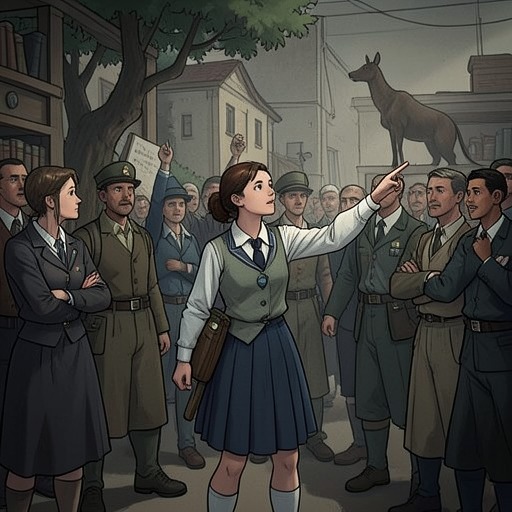
Mean GirlsLions are a real part of Cady Heron’s childhood in Africa and a recurring reference point for her attempts to understand the social order at North Shore High School. Their importance lies in that double role: they belong to the natural world she knows firsthand, while also furnishing the animal comparisons through which the story makes human status and conflict legible. The analogy helps Cady read unfamiliar behavior, but it cannot tell her how to act in a human world governed by its own rules.
Identity and Background
Cady’s parents are research zoologists, and her family spends twelve years in Africa. Her education there is homeschooled, with her mother as her teacher and her father as the substitute; the animals around her are not distant abstractions but part of the environment in which she grows up. She recalls lions among the creatures that effectively served as her classmates, alongside cheetahs, monkeys, snakes, and birds.
Her recollections connect even ordinary school subjects to animal life. Multiplication brings to mind the crowdedness of jungle-cat breeding season and the appeal of lion cubs. The detail makes her childhood education distinctive: lessons are framed by close observation of living creatures, a perspective she later carries into a very different setting.
That life changes when Cady’s mother is offered a full professorship at Northwestern University. The family leaves Africa for Evanston, Illinois, and Cady’s lion-cub lessons become a thing of the past. The move separates her from the landscape and animal life she knows just as she begins attending an American high school, where she will again try to understand a community by watching its members.
Hierarchy and Social Order
The zoological account attributed to Cady’s mother, Betsy Heron, describes social hierarchy as an established order related to survival: place in the food chain, access to resources, and the capacity to thrive under unfavorable conditions. It explains that a dominant or “alpha” creature can maintain social order, while a threat to that creature’s status can provoke aggression. Lions belong to the real animal context behind this way of thinking, even as the story’s high-school comparisons take on a more figurative role.
At North Shore High, Cady recognizes that students also mark territory. The cafeteria is divided into long-table “city-states,” each associated with specific groups; when a pretty girl catches her eye and puts a bag on the vacant seat beside her, Cady understands the unspoken rejection and moves on. Her observation echoes the idea of territory and access, but the human version is communicated through social signals rather than the biological terms of the zoological excerpt.
A map made by Janis gives Cady a more precise guide to this human environment. “Caddy’s Map to North Shore High School” breaks down the cafeteria’s groups in illustrations and labels, turning a place that had felt like a war zone into a legible social landscape. Cady compares its detail to the topographical maps her parents used in field research. The parallel is revealing: observation and classification help her navigate, but the map describes social categories, not animal species or ecological roles.
Lionesses and the Reversal of the Analogy
The account of lions later reproduced from Betsy Heron’s “Animal Hierarchies on the Savanna” focuses on lionesses and the organization of a hunt. Female lions are described as more agile and faster than males. Smaller lionesses chase prey toward the center, while larger, heavier lionesses ambush or capture it; individuals can switch roles according to which lionesses are hunting and what prey is available.
This description gives the book a model of coordinated action that is more flexible than a simple picture of one dominant animal ruling the rest. The lionesses’ roles vary with circumstance, and the hunt depends on different animals performing complementary tasks. That detail sits in productive contrast with Cady’s experiences of school hierarchies, where belonging and status appear more rigidly policed. The animal account does not prove that the human groups work the same way; instead, its specificity makes the limits of the comparison visible.
The distinction matters because the zoological material is presented as knowledge about animals, while Cady’s social interpretations are attempts to translate that knowledge into an unfamiliar human setting. Her mother’s account names concrete factors and behaviors. Cady, by contrast, reaches for animal imagery when she imagines what she might do in a conflict, then recognizes that the social situation does not permit the response that would fit her metaphor.
Cady’s Changing Use of Animal Imagery
The clearest collision between the two worlds comes when Regina George deliberately draws Cady into an exchange about Aaron Samuels’s appearance. Cady imagines the dispute as it might be resolved in the animal world: a cheetah-like leap, an attack, and a wounded gazelle as prey. She immediately sets that imagined response against the fact that this is “Girl World.” Instead of attacking, she sweeps her bangs aside and flatly repeats Regina’s requested compliment.
The scene uses animal imagery to give force to Cady’s suppressed impulse, but its decisive point is the restraint imposed by the human setting. The metaphor makes the power struggle feel physical and instinctive; Cady’s actual response, however, is social performance. Her childhood knowledge helps her picture conflict, yet it does not supply a usable script for navigating the rules of the lunch table.
Lions also return through a different kind of animal reference at the end of Cady’s arc. After the Mathletes win the state championship, Kevin gives her a blue varsity jacket with yellow sleeves and drapes it over her shoulders. Cady says she instantly feels like a normal high-school girl, and the championship medal around her neck confirms her achievement. This is not an episode about lions, but it completes the contrast between her earlier life and her new forms of belonging: the animal world shaped her earliest education, while the jacket and medal mark a place she has earned within a human school community.
Narrative Significance
Lions connect the book’s natural-history framing to its scrutiny of high-school status. The opening zoological material defines hierarchy through survival, resources, dominance, and aggression; Cady’s observations of North Shore then bring territory, group boundaries, and exclusion into view. Read together, these scenes invite comparison without making the two systems identical. A cafeteria seat can resemble territory, and a status threat can provoke hostility, but the students’ world also operates through clothing, names, slang, and tacit rules.
The contrast is especially sharp in the story’s treatment of language. Cady has to correct Principal Duvall’s pronunciation of her name, spelling it out as C-A-D-Y. Later, Gretchen calls Cady’s handmade shirt “fetch,” and Regina dismisses the word; when Gretchen tries to make it catch on again, Regina snaps that it will not happen. These exchanges show human rank being asserted through pronunciation and control of what counts as acceptable slang. Unlike the animal hierarchy described in the zoological excerpts, this authority is enacted in ordinary speech and social judgment.
The animal material therefore works in two directions. It respects Cady’s particular knowledge of wildlife, grounded in years spent with zoologist parents, rather than treating Africa as merely a decorative backdrop. At the same time, lions and lionesses help organize the book’s metaphors of dominance and conflict without becoming substitutes for the people who make choices. Cady must ultimately learn that observing a hierarchy is not the same as mastering its conventions: the animal world provides her with a language for seeing power, while human relationships demand that she discover how to live among it.